
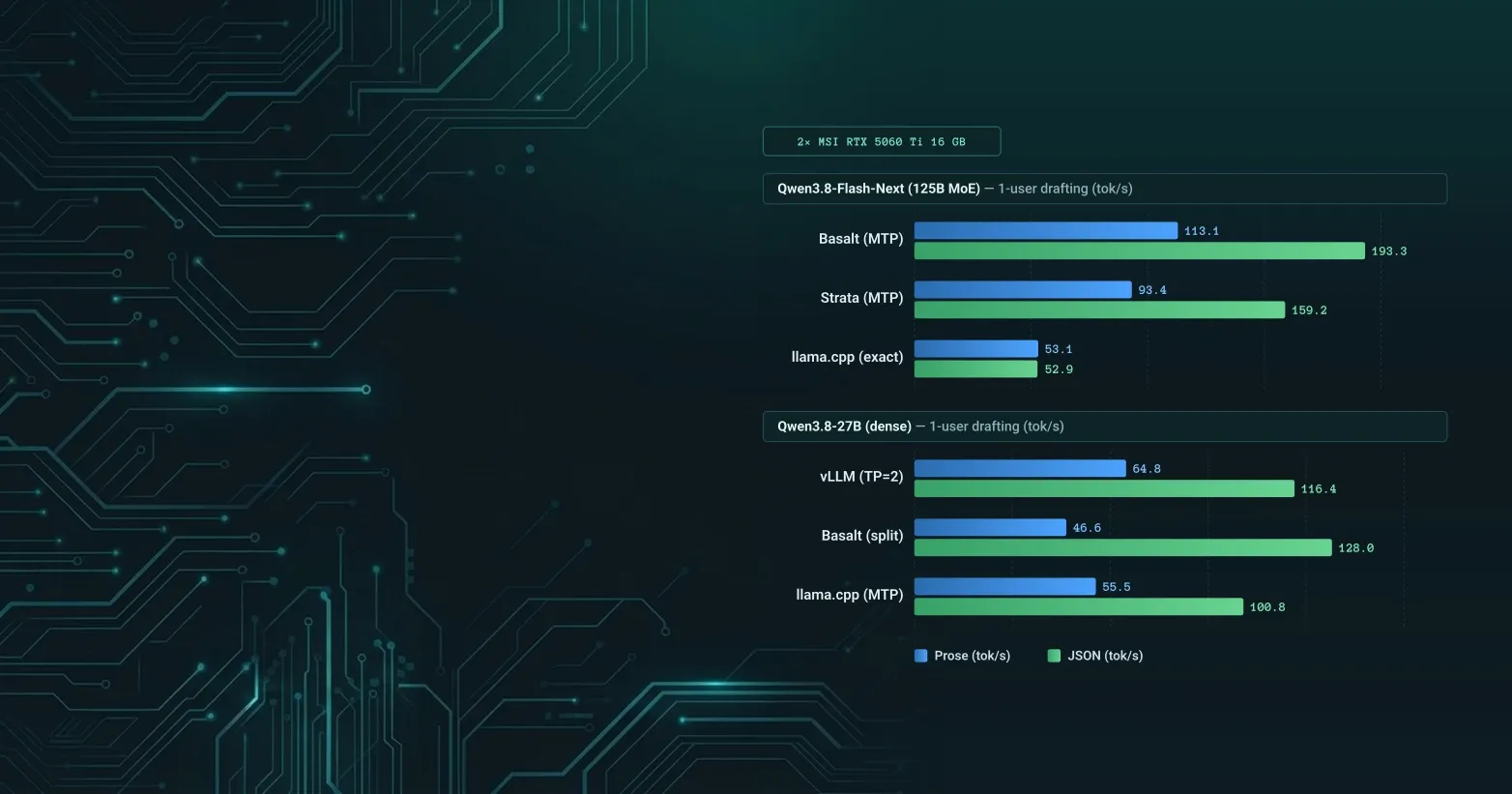
My homelab box formula has two MSI RTX 5060 Ti 16 GB, an i7-14700 and 64 GB of DDR5. Two earlier posts covered which slot the second card needs and how far llama.cpp gets with MoE models beyond VRAM. This one asks the question I actually bought two cards for: when both cards work at once, which configuration gets the most tokens per second out of each engine, and how do the best ones compare?
Two videos set the targets. One by Kai shows Basalt, a Blackwell fork of Strata, running Qwen3.8-Flash-Next about 1.4× faster than Strata (93 against 66 tokens/s on an RTX 5080). One by RepoChad runs Qwen3.8-27B with vLLM on the same two cards I have: 78 tokens/s for prose and 125 for structured output with MTP, and a 249K-token prompt in about four minutes. I reproduced both on this box, added the engines and modes the videos left out, and ran everything with the same prompts and client.
- The cross-engine analysis: every engine, every mode, the math behind the numbers
- The experiments: Strata, Basalt, vLLM on the 27B, each with a journal of every command, expected against actual, mistakes included
In short
- There is no single best engine: it depends on the model. On the MoE model the engines built for it (Basalt, Strata) win by a lot; on the dense model it is tensor parallelism for chat and Basalt’s pipeline for long documents.
- Qwen3.8-Flash-Next (125B MoE): Basalt in
peermode with its MTP drafter is the fastest for one user, 113 tokens/s prose and 193 JSON, 1.2× Strata’s best and 2.1× llama.cpp’s. For eight users at once Strata’s layer split wins, 229 tokens/s in total. - Qwen3.8-27B (dense): vLLM with tensor parallelism and MTP is the fastest chat, 65 / 116 tokens/s. Basalt is the fastest for JSON (128) and reads long prompts 2.4–2.5× faster: a 252K-token document in 114.5 s instead of 272. llama.cpp’s tensor split + MTP reaches 86–87 % of vLLM’s speed but reads prompts slowest.
- A second card rarely doubles one chat. It adds 7–35 % for one user on the MoE model, and pays off for long prompts (1.6–1.7×) and several users at once.
- Speculative decoding numbers depend on the text: the same server runs 1.8× faster on JSON than on prose. I report them apart everywhere.
- What did not matter: the NVIDIA driver (580 vs 595), a 150 W power cap (0–3 %), NCCL’s P2P switch, where the model is cut between the cards.
The setup
| GPUs | 2× MSI RTX 5060 Ti 16 GB, both on CPU lanes (Gen5 x8), no P2P |
| CPU / RAM | i7-14700, 64 GB DDR5-6000 |
| OS / driver | Ubuntu 24.04, kernel 7.0.0-43/44; NVIDIA 580.178.04 for the MoE runs, 595.91.07 (the video’s) for the 27B runs |
| Engines | Strata v0.2.21 (engine 0.1.67), Basalt v0.5.7, llama.cpp v1.0.0 (build 12359), all built from source for sm_120; vLLM 0.30.0 and 0.32.0 (official Docker images) |
| Model 1 | Qwen3.8-Flash-Next: 125B parameters, 6B active, 512 experts, GSQ-RCO IQ3_XXS (the same weights in all three engines) |
| Model 2 | Qwen3.8-27B, dense: NVFP4 for vLLM and Basalt, GGUF Q4_K_M for llama.cpp |
How I measured
- One client for every engine (
oai-bench.py) over the OpenAI-compatible API, started by one script that also samples power, VRAM and RAM. - The same requests everywhere: a prompt of about 4,300 tokens (a prose task and a JSON task on the same document), 256 tokens out, temperature 0, thinking off, nothing reused between requests. One warm-up, then five measured requests.
- Decode speed is measured by the client between the first and the last token; time to first token (TTFT) includes reading the prompt. For several requests at once, total tokens/s is every stream’s output over the wall time of the whole group.
- Long prompts: one request with a needle hidden in a document of 32K, 126K or 252K tokens. Quality: ten fixed prompts with a simple check each.
- Every number traces to a raw file in the repository. Before writing this post I regenerated every summary from the raw files and rechecked every README against them; the cross-engine analysis lists what that recheck corrected.
Two cards are not one big GPU
The cards have 16 GB each and cannot read each other’s memory, so every engine has to decide how to split a model between them. There are three ways, and they explain most of the results below:
| Split | What the cards do | One user | Long prompts, several users |
|---|---|---|---|
| Layer split (pipeline) | each card holds half the layers; they take turns for every token | no faster than one card for a dense model | the cards can work on different chunks or requests at once |
| Tensor split | every layer is split across both cards, which add up their halves after each layer | up to 2×, in practice 1.6–1.7× (the halves travel through host memory) | prompts gain little: the sums are half the work |
| Peer / helper (Basalt, Strata) | one card runs the model, the other holds extra experts and computes their rows | +7–13 % for the MoE model | Basalt also reads long prompts on both cards |
On top of that, speculative decoding (MTP or a drafter) guesses several tokens and the model checks them in one step. A step costs a little more, and yields as many tokens as were guessed right. vLLM’s numbers show it cleanly: one step takes 25.3 ms + 2.64 ms per drafted token, and with four drafts it runs 27.8 steps/s. Prose accepts 2.3 tokens per step, JSON 4.2, so the same server decodes 64 tokens/s on prose and 117 on JSON. That is why headline numbers like “224 tokens/s” are usually JSON, and why prose and JSON belong in separate columns.
Qwen3.8-Flash-Next: Basalt for one user, Strata for many
Flash-Next has 40 GiB of experts at this quant, more than both cards together. All three engines keep the most used experts on the GPUs and compute the rest on the CPU, but they differ in how they use the second card.
Best two-GPU configuration of each engine, same weights:
| llama.cpp | Strata | Basalt | vLLM | Ollama | |
|---|---|---|---|---|---|
| One user, exact (no drafting), prose / JSON | 53.1 / 52.9 | 66.9 / 66.6 | 77.4 / 78.4 | – | – |
| One user, with drafting, prose / JSON | – | 93.4 / 159.2 | 113.1 / 193.3 | – | – |
| Prompt, 4.3K tokens | 838 tokens/s | 1,878 | 1,876 | – | – |
| First token after a 126K-token prompt | 153.4 s | 36.3 s | 34.7 s | – | – |
| A four-turn conversation over a 32K document | 64.2 s | 29.0 s | 25.4 s | – | – |
| 4 users, short prompts (total) | 117 | 173 | 173 | – | – |
| 8 users, short prompts (total) | 151 | 229 | 200.5 | – | – |
(tokens/s unless stated; – = not measured: llama.cpp has no drafter for this model, and vLLM and Ollama were not run on it.) llama.cpp’s best is the configuration from the previous post on these weights: layer split, -cmoe, a 23 GiB MoE cache, DirectIO and 4096-token batches.
The fair comparison is exact against exact. Strata’s “route tail skip”, which the video is careful about, leaves out some of the least likely experts. It has been off by default since 0.2.17, and I kept it off: here it gained 0–8 % for 1.5–6 % of the experts left out, and changed one of ten answers. Exact against exact, Basalt is +14–18 % over Strata, not the 1.4× of the video’s RTX 5080 report, and +21–44 % with each engine’s drafter.
What the second card is worth:
| One user, exact | One user, drafting (prose / JSON) | 126K prompt | 4 users, short | |
|---|---|---|---|---|
| Strata (best two-card mode against one card) | +7 % | +20 % / +35 % | 1.70× faster | 1.66× |
Basalt peer against one card |
+7–9 % | +8 % / +13 % | 1.57× faster | +16 % |
| llama.cpp (best against best) | +17–25 % | – | – | – |
| vLLM | – | – | – | – |
| Ollama | – | – | – | – |
(– = not measured: llama.cpp’s one-card runs covered one user only, and vLLM and Ollama were not run on this model.)
One user is limited by the work per layer, not by missing experts: about 90 % of the routed experts already sit in one card’s cache. Long prompts and several users are where both cards really work at the same time.
The modes I tried that did not pay: Basalt’s split mode (no better than one card for one user, behind peer for batches), every gpu-share and split point, Strata’s --batch-mtp (slower), llama.cpp’s tensor split (20.6 tokens/s: its MoE cache does not work with it) and row split (does not load).
Several users with long prompts look very different. With 4.3K-token prompts, four users get 61.7 tokens/s in total on Strata and 58.2 on Basalt instead of 173: the wall time is mostly spent reading the four prompts (about 9 of 16.6 seconds for Strata). Totals are only comparable at the same prompt length.
Qwen3.8-27B: vLLM for chat, Basalt for long documents
The dense 27B does not fit one card at 4 bits plus context, so every engine here uses both. Strata cannot run it at all: its setup only builds packs for mixture-of-experts models (the Flash-Next family, Qwen3.6-35B-A3B and two others), and the 27B is dense.
The video reproduces, except for prompt reading. With the video’s pinned checkpoint and vLLM 0.30.0, decode without MTP is 42.35 tokens/s against 41.99, and on the video’s driver (595) vLLM’s KV cache pool equals the source’s to the token. MTP’s step time scales with the number of drafts within 0.4–4.2 % of the source’s at every draft length. With MTP k=4 I measured 62–78 tokens/s on prose depending on the prompt (the video: 78.3) and 116–117 on JSON (124.9): the source’s prompts are not published, and decode follows how well the drafts are accepted.
Prompt reading is the one thing that did not reproduce: 4K in 1.31 s against 0.99, 32K in 12.4 s against 10.5. It is not the driver, the power cap, NCCL’s P2P flag or its protocol. A profile of one prompt shows why: 56–57 % of the time is the all-reduce that adds up the two cards’ halves after every layer, 40 MiB at a time through host memory at 7.4 GB/s. The source’s Ryzen 9800X3D and its memory path are the likely difference, but I cannot test that on this machine.
Best two-GPU configuration of each engine:
| vLLM (TP=2) | Basalt (split) | llama.cpp (tensor split) | Strata | Ollama | |
|---|---|---|---|---|---|
| Weights | NVFP4 | NVFP4 | Q4_K_M | cannot run | Q4_K_M |
| One user, no drafting | 42.4 | 25.0 | 40.3 | – | – |
| One user, drafting, prose / JSON | 64.8 / 116.4 | 46.6 / 128.0 | 55.5 / 100.8 | – | – |
| First token, 4K / 32K prompt (no drafting) | 1.31 / 12.4 s | 0.94 / 5.19 s | 3.04 / 24.2 s | – | – |
| 252K-token prompt | 272 s | 114.5 s | 360 s | – | – |
| 4 users, 4.3K prompts, prose / JSON (total) | 94.0 / 120.2 | 84.1 / 103.3 | 49.0 / 57.6 | – | – |
| Drafting changes the answer text (of 10) | 3–4 | 0 | 0 | – | – |
(tokens/s unless stated; – = not measured. vLLM’s 4-user numbers are with the NVFP4 KV recipe and 4 slots, Basalt’s with a 164K context; vLLM and Basalt ran everything else at 262K context, llama.cpp at 40K except the 252K run. Strata cannot run dense models. Ollama was not run with these prompts: in the slot post, with a 540-token prompt, it did 42.8 tokens/s with MTP, where llama.cpp’s tensor split + MTP did 77.8.)
- vLLM wins chat: tensor parallelism uses both cards for every token, and the small sums per token cost little.
- Basalt wins prompts and JSON: its split pipelines prompt chunks over the two cards and passes each chunk once, instead of summing after every layer, and its DFlash 2 drafter is excellent at structured output. It loses on prose (−28 %).
- llama.cpp’s tensor split + MTP decodes at 86–87 % of vLLM, on other weights. The earlier board-swap test had it at 77.8 tokens/s, above vLLM, but that was a 540-token prompt; at 4.3K it is 55.5. Its prompts are slowest, and since it reads them one after another, four users get 49 tokens/s in total. One correction to the video: llama.cpp 1.0’s tensor split does take a quantized KV cache, which is how the 252K run fit (
q8_0, 15,000 MiB per card).
Is that the engines or the weights? vLLM and Basalt ran different NVFP4 files at first, so I ran both again on one checkpoint (NVIDIA’s own NVFP4, which both can read). The ordering held: vLLM +46 % plain decode and +28 % drafted prose, Basalt +15 % on JSON and 2.4–2.5× on prompts from 32K up. That checkpoint is also heavier (its attention layers are FP8, not NVFP4): vLLM decoded 24 % slower on it, and neither engine held 262K context with its drafter.
Output that does not change with drafting. All ten quality checks pass on every engine and setting. But with vLLM, turning MTP on changes the wording of 3–4 of the ten answers (a greedy tie goes the other way when the verification runs on other batch shapes). Basalt’s and llama.cpp’s drafted text is identical to their plain text, byte for byte.
What did not matter
| Change | Effect |
|---|---|
| NVIDIA driver 580 → 595 | the same speed for vLLM, Strata and Basalt (vLLM’s KV pool +0.9–2.3 %) |
| 150 W power cap instead of 180 W (tested with vLLM) | 0–3 %: vLLM averages 105–110 W per card while generating, and only its NVFP4 252K prompt drew more than 150 W (Basalt peaks at 180 W and was not tested capped) |
| The second card on chipset x4 instead of CPU x8 | ±1 % for layer split, +7–21 % for tensor split (the slot post) |
NCCL_P2P_DISABLE |
nothing: these cards have no P2P either way |
Where the model is cut, gpu-share, -ts |
nothing measurable |
What went wrong on the way
- I benchmarked the wrong model for an hour. For the matched-checkpoint runs I forgot to export
MODEL_DIR, so vLLM loaded the old checkpoint, and I spent five runs chasing out-of-memory errors on a model I was not testing. The 42.4 tokens/s should have told me. Every vLLM log is now checked for themodel:line. - My own summary disagreed with the logs. Rechecking every number before this post found a step whose two VRAM rows were swapped, one value copied into the wrong cell, and a thinking-on comparison that was not like for like: Basalt stops thinking at 400 tokens and answers, vLLM spent all 800 tokens thinking. The tables are fixed and the corrections are noted in the journals.
- The MTP config would not fit at full context on the heavier checkpoint, and I explained the out-of-memory errors three different ways before the logs settled it: the drafter needs 0.43 GiB more KV cache, and 262K tokens with it do not fit 16 GB cards at any setting that starts.
What I did not measure
vLLM on the MoE model; drafting with several long-prompt users on Flash-Next; Ollama on the 27B with these prompts (it splits by layers only, so it runs at one card’s speed: the slot post); quality beyond ten prompts, such as KL divergence against the full-precision model; and a second machine with a different CPU, which is what the prompt-reading gap to the video is really asking for.
Conclusion
Two 16 GB cards do not make a 32 GB GPU, and the best way to use them depends on the model more than on the engine. For a MoE model that does not fit in VRAM, use an engine built for it: Basalt in peer mode for one user, Strata’s layer split for many. For a dense model that does, use tensor parallelism for chat (vLLM, or llama.cpp’s tensor split at 86 % of it) and a pipelined split for long documents (Basalt reads them 2.4× faster). And whatever a headline number says, ask whether it is prose or JSON, one user or eight, a 500-token prompt or a 32K one. The full tables, the math and the gaps are in the analysis.